Skin cancer treatment
The most appropriate treatment depends on:
- the type of skin cancer
- the size and location of the tumor
- the patient’s age, overall health, and cosmetic considerations
Topical medications, light-based treatments, laser therapy, radiation therapy, and surgical procedures are the most commonly used treatments. Systemic therapy is used in cases of advanced disease.
Topical treatments are typically used for precancerous lesions or low-risk basal cell carcinoma. While basal cell carcinoma is most often treated with curettage or surgical excision, squamous cell carcinoma is usually treated with surgical excision or radiation therapy.
Dermatology guidelines and national multidisciplinary clinical guidelines are being developed in Denmark to ensure consistent, evidence-based treatment across the country.
1. Topical medications (medicated creams)
Topical medications are used to treat precancerous lesions and superficial basal cell carcinoma. Treatment is often applied to larger areas of sun-damaged skin and may reduce the risk of new lesions.
Treatment is performed at home, and patients apply the medication themselves. The cream should only be applied to the areas specified by the doctor, as the skin reaction can be significant.
What does topical treatment mean for you as a patient?
Some topical medications may cause redness, irritation, and skin breakdown or crusting. In some cases, the reaction may be strong enough that treatment needs to be paused. Any treatment interruption should be discussed with your doctor.
After completing treatment, it may take several weeks for the skin to fully heal, depending on the specific medication used.
Approved topical treatments in Denmark
- Imiquimod - activates the immune system locally, helping the body destroy abnormal cells. Used for precancerous lesions and certain types of skin cancer
- 5-fluorouracil (5-FU) - interferes with cell division in the outer skin layers and is used to treat precancerous lesions and some superficial skin cancers
- Diclofenac - a milder topical treatment used for thinner actinic keratoses
- Tirbanibulin - a newer treatment that inhibits cellular growth pathways and is used for actinic keratoses on the face and scalp
Topical inhibitors of the hedgehog signaling pathway are also currently being studied in clinical trials.
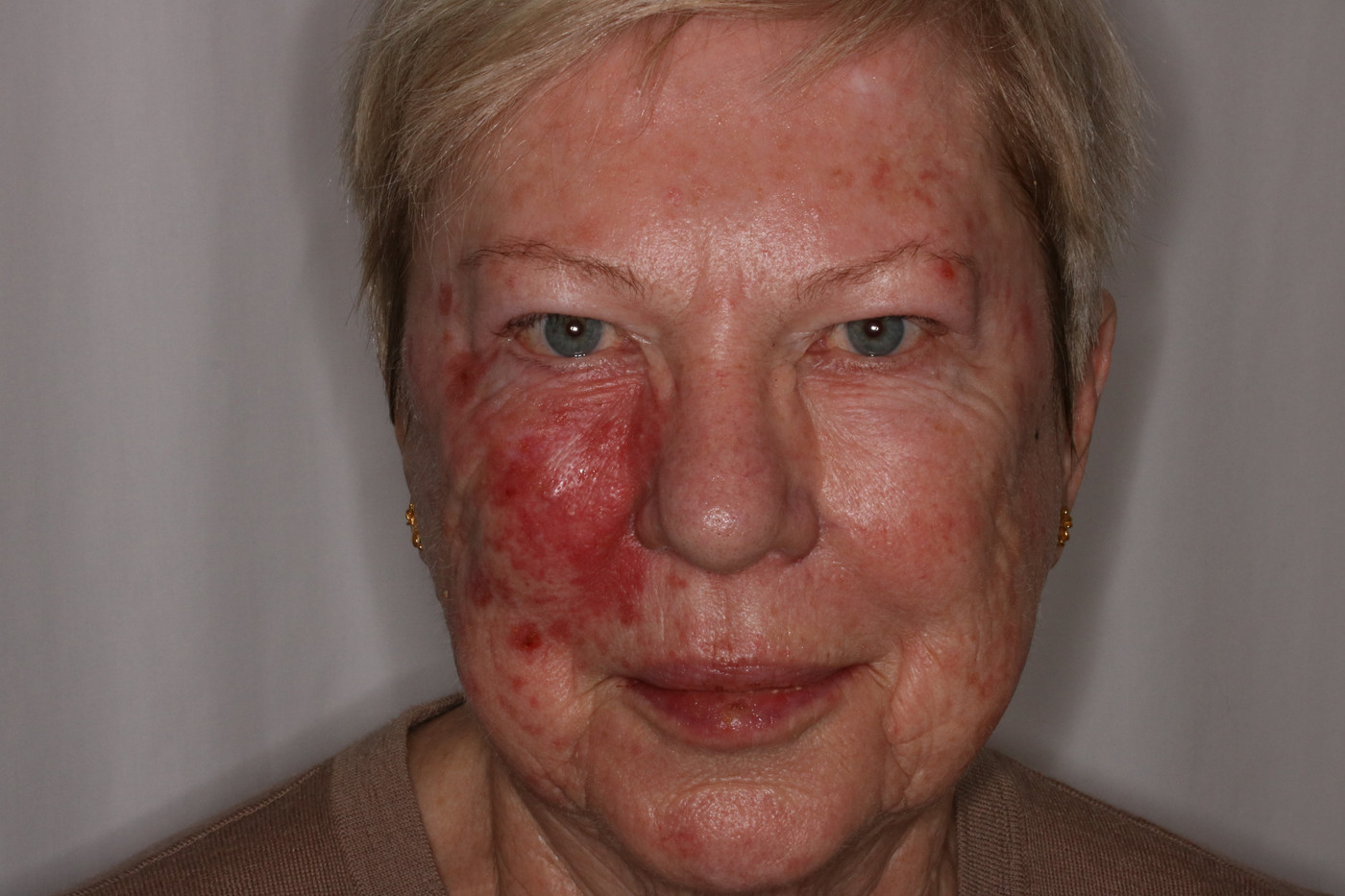
Reaction on skin after a 7-days treatment with Tolak creme (red side of the face)
2. Photodynamic therapy (PDT)
Photodynamic therapy is used primarily to treat precancerous lesions (actinic keratoses and Bowen’s disease) and superficial basal cell carcinoma. Treatment is performed in a hospital or dermatology clinic.
After gentle preparation of the skin surface, a light-sensitive medication (5-aminolevulinic acid or methyl aminolevulinate) is applied. The abnormal cells absorb the medication and become sensitive to light. When the area is exposed to a specific light source, the activated medication selectively destroys abnormal cells while minimizing damage to surrounding healthy tissue.
Conventional PDT
- Used for actinic keratoses, superficial basal cell carcinoma, and Bowen’s disease
- The treatment area is prepared, the medication is applied, and the area is covered for approximately 3 hours
- The area is then exposed to red LED light for 7-9 minutes
- Some patients experience burning or stinging sensations during treatment, which can be relieved with cooling measures
Daylight PDT
- Used especially for widespread actinic keratoses
- After medication is applied, the skin is exposed to daylight for approximately 2 hours
- This treatment is generally well tolerated and causes minimal discomfort
Laser-assisted PDT
In treatment-resistant cases, fractional laser treatment may be used before PDT to improve medication absorption and treatment effectiveness.
What does PDT mean for you as a patient?
After treatment, the skin typically becomes red and swollen, and crusting may develop. Healing usually occurs within 1–2 weeks. Sun protection is especially important during the healing period.
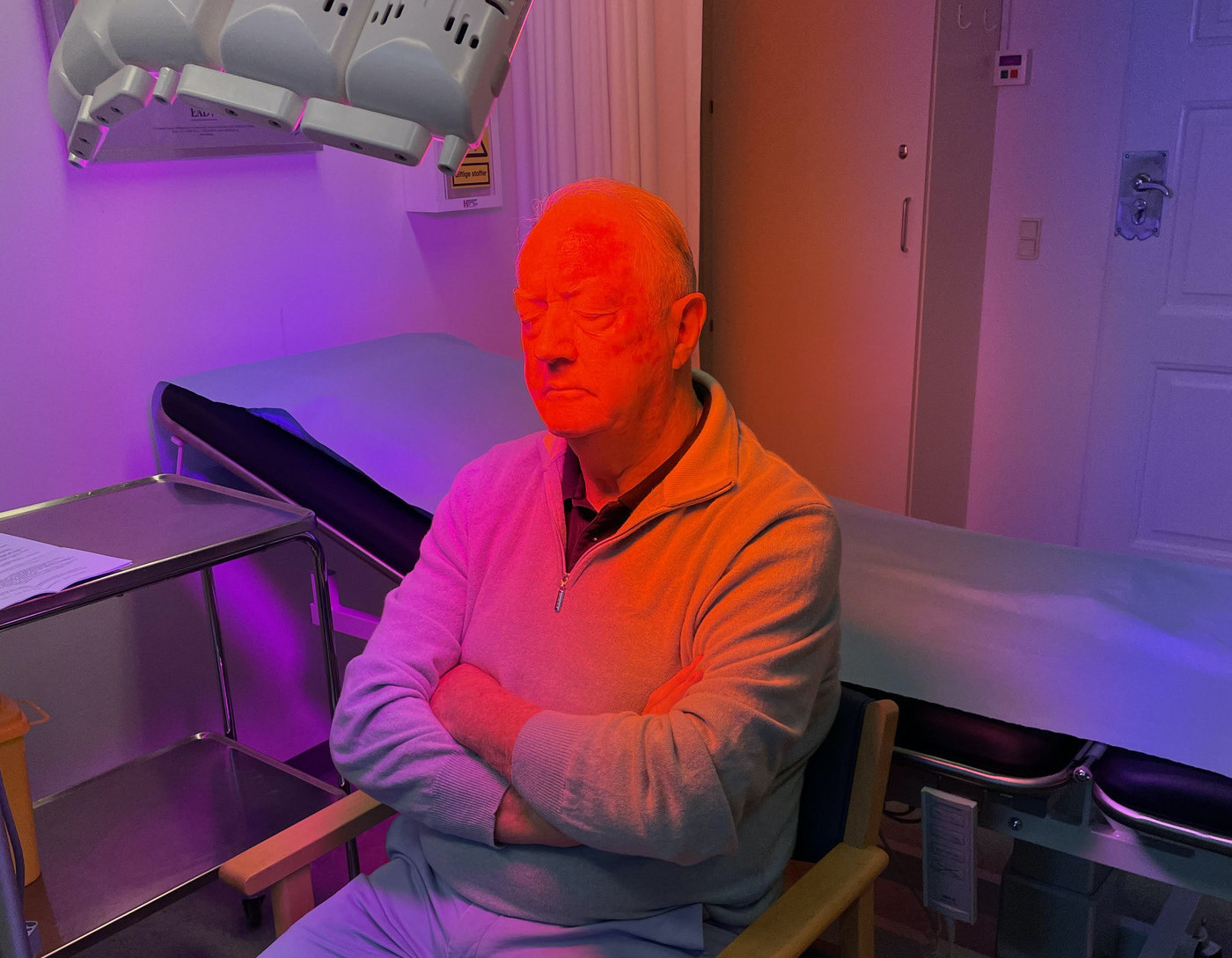
Patient receiving indoor daylight PDT.
3. Radiation therapy
Squamous cell carcinoma can sometimes be treated with radiation therapy, particularly when surgery is not feasible or is not preferred. Radiation therapy is provided by oncology specialists in a hospital setting.
4. Surgical treatment
Surgery is the most effective treatment for most basal cell carcinomas and squamous cell carcinomas. The choice of surgical technique depends on the type, size, and location of the tumor. Treatment is performed in a hospital or dermatology clinic.
Curettage and electrodessication
- The tumor is removed by scraping (curettage) followed by controlled electrical destruction of remaining cancer cells
- Used for small, low-risk tumors
- Performed under local anesthesia
Standard surgical excision
- The visible tumor is removed along with a margin of normal-appearing tissue
- The wound is closed with stitches (sutures), and the tissue is examined under a microscope
- If cancer cells are found at the margins, additional surgery may be needed
Mohs surgery (Mohs micrographic surgery)
- A highly precise, tissue-sparing technique commonly used for basal cell carcinoma, especially on the face or in recurrent cases
- The tumor is removed in thin layers under local anesthesia
- Each layer is immediately examined under a microscope
- The process is repeated during the same procedure until all cancer cells are removed
What does surgical treatment mean for you as a patient?
Surgery may cause temporary discomfort and will usually result in a scar. However, surgical treatment offers very high cure rates.
5. Systemic treatment
For advanced or metastatic skin cancer, oncologists may use systemic treatments such as:
- Hedgehog pathway inhibitors (for advanced basal cell carcinoma)
- Immunotherapy, such as immune checkpoint inhibitors (for advanced squamous cell carcinoma or other skin cancers)